How to Beat the CPU in Retro Ping Pong (Easy, Normal and Hard)
Published · 3 min read
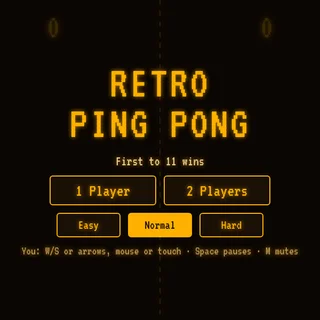
The computer in Retro Ping Pong is not magic. It watches the ball, works out where it will cross its own line — bounces off the walls included — and moves its paddle there. What changes between Easy, Normal and Hard is how fast it moves, how early it starts looking and how accurately it aims. Once you know that, you know how to beat it.
How the CPU thinks
While the ball is travelling away from it, the computer drifts its paddle back to the middle of the court. When the ball turns towards it and crosses its reaction line, it predicts the crossing point and commits to it, with a small error added. On Easy that line is just past the net, so the computer has little time to get there, and its paddle moves at a bit over half your top speed. Normal reads the ball a little earlier and moves faster. Hard starts reading the ball on your side of the net and moves almost as fast as you.
Two details matter. The prediction is made once per approach, so a mistake is not corrected on the way. And the error grows with the speed of the ball: a fast ball is harder for the computer to judge, just as it is for you.
Rule one: aim with the edges
The paddle is 100 pixels tall. Where the ball touches it sets the new angle: dead centre sends it straight back, and the further from the centre, the steeper it leaves. A ball that hits a few pixels from the end leaves at almost the full angle and will bounce off a wall before it reaches the other side. Steep balls give the computer more distance to cover in the same time, and they are the ones it misjudges.
To hit with the edge on purpose, do not centre your paddle on the ball. Stop slightly early, so the ball meets the top or bottom of the paddle. With the mouse this is easy: point a little above or below the ball.
Rule two: let the speed build
Every return makes the ball faster, up to a cap of more than double the serving speed, and the speed resets after each point. Early in a rally the computer can reach anything. Late in a rally, especially on Easy and Normal, it starts to arrive a moment too late. If you can keep returning, a long rally usually ends in your favour. Keep your own returns safe early and save the steep edge shots for when the ball is already fast.
Rule three: stay central
After you hit the ball, move back towards the middle of your side. From the centre, no crossing point is more than half the court away. Chasing a ball from the far corner is how most points are lost on Hard.
Level by level
- Easy: it reacts late and moves slowly. Almost any angled shot scores. Use it to practise hitting with the edges.
- Normal: it returns flat balls reliably. Build a rally, then play the steep edge shot once the ball is fast.
- Hard: it starts moving early and rarely misses a flat ball. Only fast, steep returns — ideally ones that bounce off a wall near its side — get past it. Expect long rallies.
Serves
After a point the ball blinks in the centre for a second, then goes towards the player who just lost the point, from a random height. Use the blink to get to the middle. Do not guess high or low; wait until it moves.
Your wins and losses against each level are saved in the browser and shown on the menu. Play Retro Ping Pong and see how long it takes to get a winning record on Hard.
More from the blog
- From Pong (1972) to Retro Ping Pong: What Stayed and What Changed
The arcade original, the paddle-angle trick that made it a game of skill, and what this browser version keeps and adds.