From Pong (1972) to Retro Ping Pong: What Stayed and What Changed
Published · 3 min read
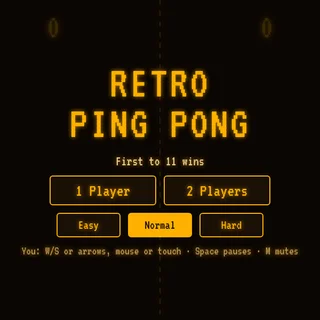
Pong is one of the first video games most people ever saw: two paddles, a square ball and a score at the top of the screen. Retro Ping Pong is a new version of that idea, and it keeps the parts that made the original work. Here is what those parts are, where they came from, and what this version adds.
Pong in 1972
Atari released the Pong arcade cabinet in 1972. It was built by engineer Allan Alcorn, and it was simple enough to understand without instructions: two players turned knobs to move paddles up and down, and the ball bounced between them. The first player to 11 points won. The game used no microprocessor at all — the whole thing was wired logic — and its three sounds, for a paddle hit, a wall bounce and a point, were blips taken straight from the circuit.
One detail made Pong more than a toy. The paddle was divided into segments, and the segment the ball hit decided the angle it came back at. A hit on the edge sent the ball away steeply. Players learned to aim, and the game became a contest of skill instead of luck.
What Retro Ping Pong keeps
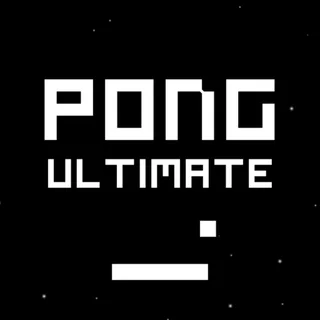
- The court. A black field, a dashed centre line, a paddle near each end and a square ball. The scores sit at the top, one over each half.
- Aiming by paddle position. Where the ball meets your paddle sets its angle: flat from the middle, steep from the ends. Instead of fixed segments the angle changes smoothly along the paddle.
- First to 11. A match has an end. When someone reaches 11 the game shows the result and the menu comes back.
- Three blips. The paddle, wall and point sounds are short square-wave tones, tuned to the pitches usually quoted for the original cabinet. Press M if the room would rather not hear them.
What it adds
The game this site runs is based on Retro Pong, an open-source HTML5 Pong by Mehmet T. Akalın. His version had the court, the two paddles and a computer opponent that predicts where the ball will arrive. This copy adds the rest of a finished game:
- A computer opponent at three levels. Easy, Normal and Hard change how fast the computer paddle moves, how early it reads the ball and how well it aims. Your record against each level is saved in the browser.
- A ball that speeds up. Each return makes it a little faster, and it slows back down after every point, so rallies build tension the way they do on a real table.
- A proper serve. After each point the ball blinks in the centre for a second and then goes towards the player who conceded.
- More ways to play. Keys, a mouse or a finger. Two players can share a keyboard, or a tablet with one player on each half of the screen.
- A CRT look. Amber phosphor, a fading trail behind the ball and faint scanlines, like a monochrome monitor from the era.
Why it still works
Pong has survived fifty years because the whole game is visible at once and every point is decided by one thing: whether you got your paddle there in time, and what you did with it. There is nothing to unlock and nothing to read. Two people can sit down and play a match in three minutes, and the better player usually wins.
If you are new to it, start against Easy and practise hitting with the ends of the paddle. Then read how to beat the CPU, or just start a match.
More from the blog
- How to Beat the CPU in Retro Ping Pong (Easy, Normal and Hard)
How the computer paddle reads the ball, why edge hits and fast rallies beat it, and what changes on each difficulty level.